
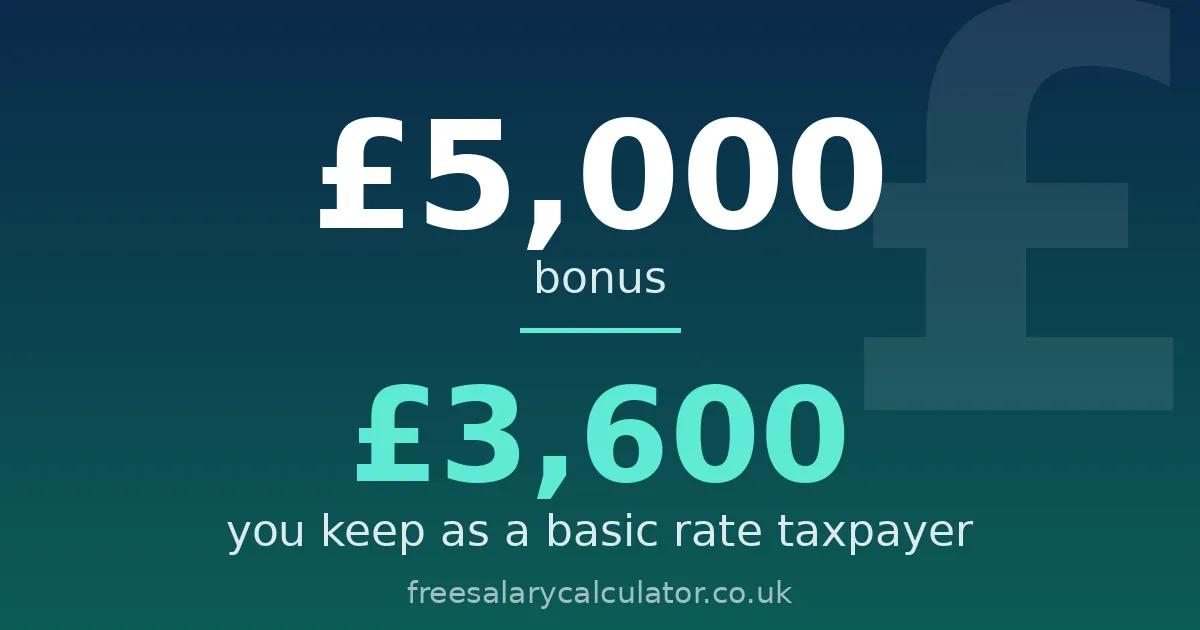
The tax on a £5,000 bonus depends on your salary. A basic rate taxpayer keeps about £3,600 after £1,000 of income tax and £400 of National Insurance. A higher rate taxpayer keeps about £2,900, and near £100,000 the personal allowance taper can cut what you keep to about £1,900.
How much tax is taken from a £5,000 bonus?
There is no separate bonus tax in the UK. Your bonus is added to your salary and taxed as ordinary pay, so the tax on a £5,000 bonus is simply your marginal rate applied to £5,000. Your marginal rate is the rate on the next pound you earn, and it decides how much you keep.
Income tax and National Insurance both apply to a bonus. The table shows the combined rate for each band in England, Wales and Northern Ireland for 2026/27, using the rates published by HMRC.
| Where the bonus sits | Income tax | National Insurance | Taken off | You keep |
|---|---|---|---|---|
| Basic rate, £12,570 to £50,270 | 20% | 8% | 28%, or £1,400 | £3,600 |
| Higher rate, £50,270 to £125,140 | 40% | 2% | 42%, or £2,100 | £2,900 |
| Additional rate, above £125,140 | 45% | 2% | 47%, or £2,350 | £2,650 |
Scotland sets its own income tax bands, so a Scottish taxpayer pays Scottish rates on the bonus instead. National Insurance is the same across the UK. Our UK income tax guide sets out every band and threshold for 2026/27.
Why does a £5,000 bonus feel so heavily taxed?
Most people first meet bonus tax on a single payslip, and that payslip often looks worse than the annual figures above. When your bonus lands, your employer adds it to that month’s pay, and PAYE treats the month as if you earned that much every month.
Take a salary of £45,000, where normal monthly pay is £3,750. In the bonus month your pay jumps to £8,750, and PAYE can tax part of it as if your annual income were far higher, so that month can show a 40% deduction even though your annual income stays in the basic rate band.
PAYE is cumulative, so it usually corrects itself through later payslips or a tax code change, and by the end of the year you have paid the right annual amount. If the tax year ends and you still seem overtaxed, check your personal tax account with HMRC.
What happens when a £5,000 bonus crosses the higher rate threshold?
A bonus that crosses the £50,270 higher rate threshold is split in two. The slice below the threshold is taxed at 20% plus 8% National Insurance, and only the slice above it is taxed at 40% plus 2%. You never pay 40% on the whole bonus just because part of it crosses the line.
Take a salary of £48,000 with a £5,000 bonus. The first £2,270 fills the basic rate band up to £50,270, and it loses £454 of income tax and £181.60 of National Insurance. The remaining £2,730 sits in the higher rate band, and it loses £1,092 of income tax and £54.60 of National Insurance.
Put together, the bonus loses £1,546 of income tax and £236.20 of National Insurance, a total of £1,782.20, so you keep £3,217.80. The annual figures confirm it: take home pay on £48,000 is £38,079.60 a year and on £53,000 it is £41,297.40, a difference of exactly £3,217.80. You can check the same maths on our £40,000 after tax and £30,000 after tax pages.
How much tax on a £5,000 bonus at different salaries?
The table shows the tax on a £5,000 bonus at five salaries, with no student loan and no pension sacrifice. Each row compares take home pay on the salary alone with take home pay on the salary plus the bonus, using the verified 2026/27 engine.
| Salary | Income tax | National Insurance | You keep |
|---|---|---|---|
| £30,000 | £1,000 | £400 | £3,600 |
| £40,000 | £1,000 | £400 | £3,600 |
| £48,000 | £1,546 | £236.20 | £3,217.80 |
| £60,000 | £2,000 | £100 | £2,900 |
| £110,000 | £3,000 | £100 | £1,900 |
The £30,000 and £40,000 rows look identical because both bonuses sit fully inside the basic rate band. On £60,000 the whole bonus is taxed at 40% plus 2% National Insurance, so you keep £2,900.
The £110,000 row is the harshest. Income above £100,000 loses £1 of personal allowance for every £2 earned, so the bonus loses £3,000 of income tax instead of £2,000. That is the 60% trap in action, and it leaves only £1,900 of the bonus in your pocket.
For scale, the ONS Annual Survey of Hours and Earnings puts median full time pay at £40,911 a year, so a £5,000 bonus is worth about 12% of a typical full time salary.
Does a student loan change the tax on a £5,000 bonus?
Yes, if you are still repaying a student loan. A student loan is not a tax, but it is deducted from your pay in the same way, and it comes off the bonus too. A Plan 2 loan takes 9% of earnings above £29,385 a year, so a £5,000 bonus on a salary above that threshold loses an extra £450.
On a £40,000 salary with a Plan 2 loan, the bonus loses £1,000 of income tax, £400 of National Insurance and £450 of student loan, so you keep £3,150 instead of £3,600. Every loan plan works the same way, each with its own threshold, so check which plan you are on before you count the bonus as spent.
Pension contributions taken from your pay also reduce the bonus, but they work in your favour. Money paid into a workplace pension escapes income tax, and salary sacrifice also escapes National Insurance, so it lands in your pension pot instead of going to HMRC.
How can you keep more of a £5,000 bonus?
Salary sacrifice into your pension is the main legal way to cut the tax on a £5,000 bonus. If your employer lets you sacrifice the bonus into your pension, the sacrificed amount escapes income tax and National Insurance entirely. A basic rate taxpayer who sacrifices the whole £5,000 keeps it all in their pension instead of £3,600 cash.
The trade is real: the money is locked in your pension until you can access it, so it only suits a bonus you do not need for bills. Ask payroll whether your employer offers bonus sacrifice, because it must be agreed before the bonus is paid.
Timing the bonus across the tax year rarely helps on its own. Income tax is worked out on your annual total, so moving a bonus from March to April changes which tax year it falls in, but not the rate, unless it moves you across a threshold.
A bonus that pushes you just over £100,000 is the one case where timing or sacrifice can save real money, because it avoids the personal allowance taper. Our bonus versus pay rise guide compares a one off bonus with a permanent rise if you have a choice between the two.
How do you check the tax on your £5,000 bonus?
Follow these steps on the payslip for the bonus month.
- Find the gross bonus on your payslip and confirm it is £5,000 before deductions.
- Compare the income tax and National Insurance on the bonus month with a normal month. The difference is the tax on a £5,000 bonus.
- Check the year to date figures on the payslip, which show your total pay and total tax so far and reveal whether PAYE has over deducted in the bonus month.
- Work out your expected annual total: salary plus bonus. If the total stays under £50,270, the bonus should cost 28% in total, and if it crosses £50,270, only the slice above that line should cost 42%.
- Run the numbers on our free salary calculator with your salary, then again with your salary plus £5,000, and compare the take home figures.
- If the tax year has ended and you still look overtaxed, check your personal tax account with HMRC.
Knowing the tax before your £5,000 bonus lands stops the payslip surprise. A basic rate taxpayer keeps about £3,600 and a higher rate taxpayer keeps about £2,900, and the only way the number drops much lower is a student loan or the personal allowance taper above £100,000. Now you know the tax on a £5,000 bonus at your salary, so you can plan the money before it arrives.
Frequently asked questions
How much tax will I pay on a £5,000 bonus?
The tax on a £5,000 bonus depends on your salary. A basic rate taxpayer pays £1,000 of income tax and £400 of National Insurance and keeps £3,600. A higher rate taxpayer pays £2,000 of income tax and £100 of National Insurance and keeps £2,900.
Is a bonus taxed at 40%?
No, there is no separate 40% bonus rate. A bonus is taxed at your marginal rate, so only the slice of income above £50,270 is taxed at 40%. It can look taxed at 40% on one payslip because PAYE treats the bonus month as if you earned that much every month.
Do I pay National Insurance on a bonus?
Yes. Employee National Insurance applies to a bonus at 8% on earnings up to £50,270 a year and 2% above that. On a £5,000 bonus that is £400 for a basic rate taxpayer and £100 for a higher rate taxpayer.
Will a £5,000 bonus push me into the 40% tax band?
Only the part above £50,270 is taxed at 40%. If your salary is £48,000, the first £2,270 of the bonus stays at 20% and only the remaining £2,730 is taxed at 40%. Your whole salary is never pushed into the higher band by one bonus.