
Does overtime push you into a higher tax bracket? Yes, but only the pay above the line is taxed at the higher rate. In England that line is £50,270 in 2026/27, so overtime that lifts your total past it pays 40% on the slice above it, while everything below it stays at 20%.
Does overtime push you into a higher tax bracket?
Yes, it can. HMRC does not treat overtime as a separate kind of pay: your overtime is added to your salary and taxed through PAYE at the same rates as everything else you earn.
There is no special overtime tax rate and no penalty for working extra hours. What changes is your total income for the year, which decides which tax band each pound falls into.
In England, Wales and Northern Ireland the first £12,570 is tax free thanks to the personal allowance. Income from £12,571 to £50,270 is taxed at 20%, income from £50,271 to £125,140 is taxed at 40%, and anything above £125,140 is taxed at 45%.
Scotland sets its own bands, with the 42% higher rate starting at £43,662. Wherever you live, only the slice above the line pays the higher rate.
You can read how UK income tax bands work for the full picture. The official rates are published on the GOV.UK income tax rates page.
Worked example: a £48,000 salary plus £4,000 of overtime
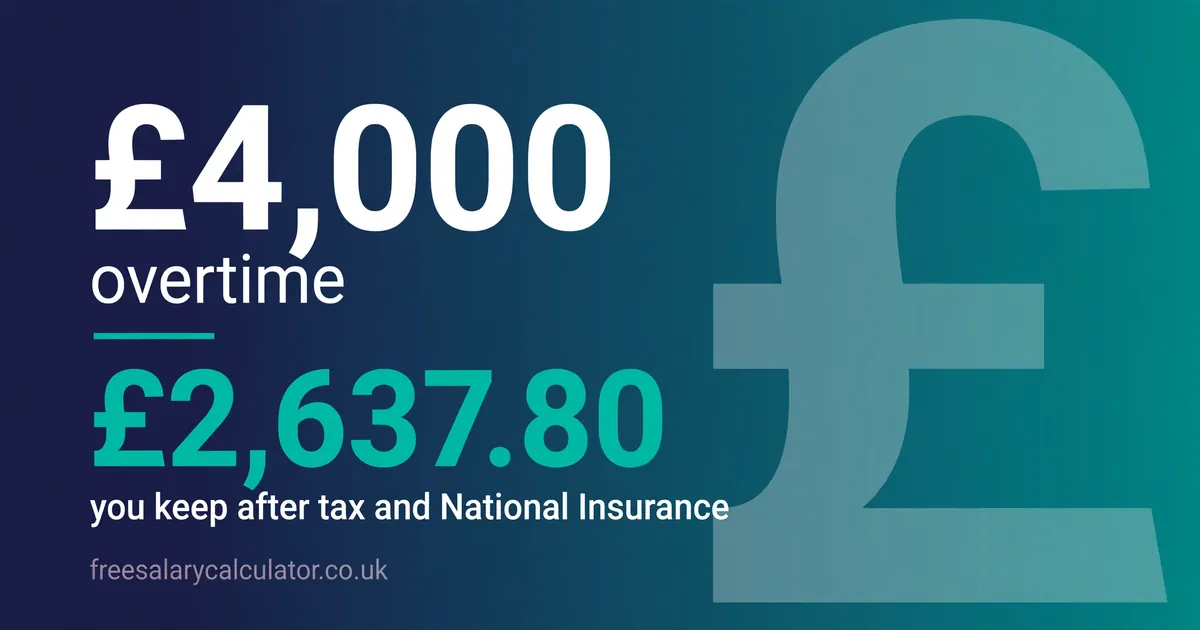
Take a worker on a £48,000 salary who earns £4,000 of overtime across the year, giving a total income of £52,000. So does overtime push you into a higher tax bracket here? Yes, but only £1,730 of the overtime crosses the £50,270 line.
The other £2,270 stays in the basic rate band.
| Figure | £48,000 salary only | £52,000 with overtime |
|---|---|---|
| Income tax | £7,086 | £8,232 |
| National Insurance | £2,834.40 | £3,050.60 |
| Take home pay | £38,079.60 | £40,717.40 |
| Take home pay a month | £3,173.30 | £3,393.12 |
These figures come from our verified 2026/27 engine, cross checked against the live salary pages. The £4,000 of overtime costs £1,146 in extra income tax and £216.20 in extra National Insurance, so the worker keeps £2,637.80.
The first £2,270 of overtime is taxed at 20% plus 8% National Insurance, which takes £635.60. The remaining £1,730 is taxed at 40% plus 2% National Insurance, which takes £726.60.
For the full month by month numbers, see our £48,000 after tax breakdown and our £50,000 after tax breakdown.
What happens when overtime takes you past £100,000?
Above £100,000 your personal allowance shrinks by £1 for every £2 of income, until it reaches zero at £125,140. That taper creates an effective 60% marginal rate on income between £100,000 and £125,140.
Each extra £1 in that zone is taxed at 40% and also pulls 50p of tax free allowance into tax. Add 2% National Insurance and the true marginal rate is 62%.
So does overtime push you into a higher tax bracket at this level? It pushes you into the most expensive band in the UK tax system, though the headline rate is still 40%.
On a £95,000 salary you pay £25,432 of income tax and £3,910.60 of National Insurance, leaving £65,657.40. Add £10,000 of overtime and your total becomes £105,000, with take home pay of £70,457.40.
The £10,000 of overtime puts only £4,800 in your pocket. That is an effective rate of 52% on the overtime.
If your salary sits near £100,000, salary sacrifice into your pension can be worth a look, because it cuts the income that counts for the taper. You can work out your take home pay with our free UK salary calculator before you decide.
Why does overtime look more heavily taxed on one payslip?
Many people ask does overtime push you into a higher tax bracket after one heavy month. Usually PAYE taxed that month as if you earned at that level all year, because PAYE works on a cumulative basis.
A big overtime month can use up more than that month’s share of the basic rate band, so part of it is taxed at 40% even though your pay for the whole year stays below £50,270. Later quiet months balance it out.
The exception is an emergency tax code, which ends in W1, M1 or X. On one of those codes, tax is worked out on that week or month’s pay only, so a large overtime payment is not balanced out by quieter months until HMRC replaces the code. National Insurance works differently again: it is calculated on each pay period alone, so a big overtime month raises it straight away and quieter months do not claw it back.
What does overtime do to National Insurance, student loans and Child Benefit?
National Insurance is charged on overtime at the same rates as your normal pay: 8% on earnings between £12,570 and £50,270 a year in 2026/27, and 2% above that. The rates go down as income rises, which is the opposite of income tax, so the combined marginal rate on basic rate overtime is 28% while on higher rate overtime it is 42%.
Student loan repayments also rise with overtime. With a Plan 2 loan you repay 9% of earnings above £29,385 a year, so on a £35,000 salary with £2,000 of overtime, that is £180 a year in extra loan repayments. Child Benefit can be affected too: the High Income Child Benefit Charge starts above £60,000 of adjusted net income, according to GOV.UK.
How much do you keep from £100 of overtime?
This table shows what you keep from £100 of overtime at each income level in England, Wales and Northern Ireland in 2026/27. So when you ask does overtime push you into a higher tax bracket, this is the answer in cash terms.
| Your total income | Tax and National Insurance on £100 | You keep |
|---|---|---|
| Below £12,570 | £0 | £100 |
| £12,570 to £50,270 | £28 | £72 |
| £50,271 to £100,000 | £42 | £58 |
| £100,000 to £125,140 | £62 | £38 |
| Above £125,140 | £47 | £53 |
Below the personal allowance you keep the lot, in the basic rate band you keep £72 of every £100, and once overtime pushes you over £50,270 you keep £58. The worst spot is the taper zone between £100,000 and £125,140, where you keep only £38, though above £125,140 the rate improves slightly to £53 because the personal allowance is already gone.
How to check your payslip after a big overtime month
A quick payslip check tells you whether the tax on your overtime is right. Work through these steps after any month with heavy overtime.
- Add up your gross pay so far this tax year, which runs from 6 April to 5 April. If your year to date pay is below £50,270, none of it should be taxed at 40% yet.
- Check your tax code: the standard code is 1257L, and if it ends in W1, M1 or X you are on an emergency code.
- Look at the National Insurance line separately: 8% of pay above £1,048 a month and 2% above £4,189 a month.
- Check for a student loan deduction: with a Plan 2 loan it is 9% of earnings above £29,385 a year.
- Use our £35,000 after tax breakdown as a sense check, or run your salary plus overtime through the calculator on our homepage. If the numbers do not match, ask your payroll team first.
Is overtime still worth it?
For most people, yes. Even in the higher rate band you keep £58 of every £100 of overtime, and in the basic rate band you keep £72. The only time to pause is in the taper zone between £100,000 and £125,140, where you keep only £38 of every £100, or when overtime pushes your household into the Child Benefit charge.
A bonus is taxed in exactly the same way as overtime, so the same bands apply. See our guide to how much tax you pay on a £5,000 bonus for a worked example at both rates.
Frequently asked questions
Does overtime push you into a higher tax bracket?
Yes, it can. Overtime is added to your salary and taxed at your marginal rate, so if your total income passes £50,270 in England, Wales and Northern Ireland in 2026/27, the slice above that line is taxed at 40%.
Is overtime taxed at a higher rate than normal pay?
No. There is no separate overtime tax rate.
Overtime is taxed at the same rates as your normal pay. It can feel more heavily taxed because your salary already uses up your tax free allowance.
Why was so much tax taken from my overtime this month?
PAYE works on a cumulative basis, so a big overtime month can use up more than that month’s share of the basic rate band. Part of the overtime is then taxed at 40% for that month, even if your pay for the whole year stays below £50,270.
Do I pay National Insurance on overtime?
Yes. Employee National Insurance applies to overtime at 8% on earnings between £12,570 and £50,270 a year, and 2% above that. It is worked out on each pay period alone, so a big overtime month raises it straight away.
The verdict
So does overtime push you into a higher tax bracket? Yes, it can, but the effect is smaller than most people fear. Only the pay above £50,270 is taxed at 40%, and you still keep £58 of every £100 of overtime in the higher rate band.
The real trap is the taper zone above £100,000, where you keep only £38. Check your payslip after a big month and run your numbers through our free calculator before you turn extra hours down.