
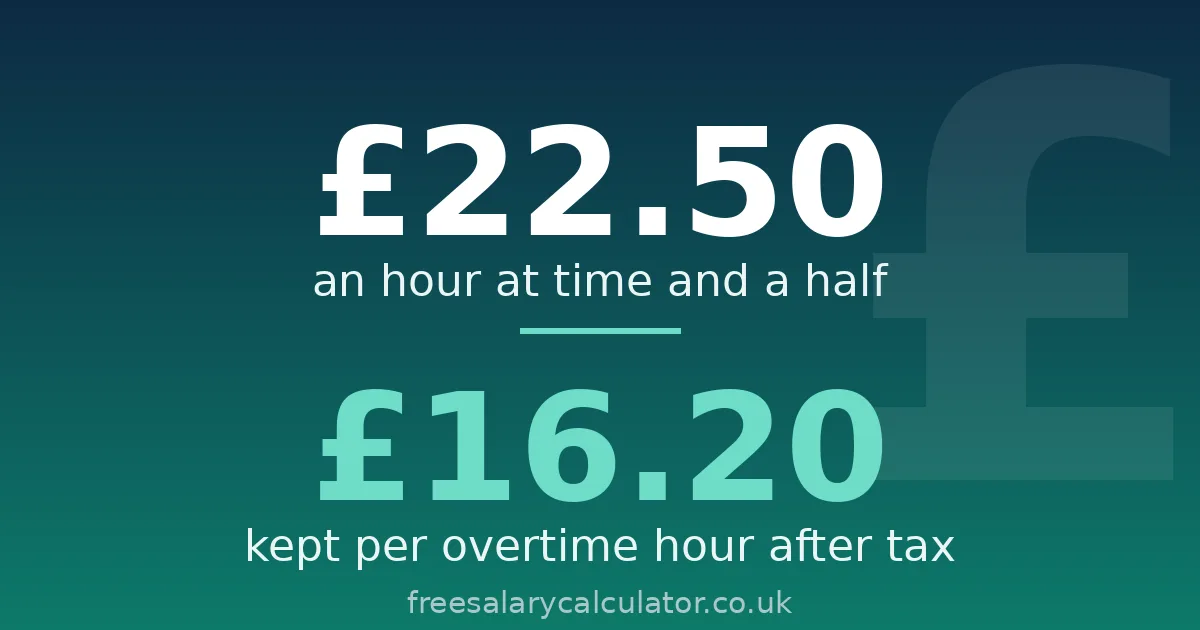
Time and a half pay after tax means you keep 72p in every £1 of weekend overtime if you pay basic rate tax. On £15 an hour, time and a half is £22.50 an hour before tax, and £16.20 an hour after 20% income tax and 8% National Insurance. Higher rate taxpayers keep 58p in the pound.
Weekend work pays better than weekday work in many jobs, and time and a half is the most common premium rate in the UK. It usually applies to Saturday shifts and to hours worked beyond your contracted week, though the exact rule sits in your employment contract. This guide works out time and a half pay after tax with real 2026/27 figures, so you can see what a Saturday shift is really worth before you agree to it.
What is time and a half?
Time and a half means your hourly rate multiplied by 1.5. On £15 an hour it is £22.50 an hour, on £18 an hour it is £27 an hour, and on the National Living Wage of £12.71 an hour it is £19.07 an hour. The extra 50% is the premium your employer pays for unsocial hours, and it is the rate most UK employers use for Saturday work and for weekday hours beyond your contract.
There is no UK law that forces an employer to pay time and a half. The Employment Rights Act 1996 and the Working Time Regulations 1998 set rules on maximum hours and rest breaks, but neither one sets an overtime rate. Your contract decides whether you get time and a half, double time, your normal rate, or time off in lieu.
The one legal floor is the National Minimum Wage: your total pay divided by your total hours must never fall below it, even in a week with unpaid overtime. GOV.UK publishes the current rates, and from April 2026 the National Living Wage is £12.71 an hour for workers aged 21 and over. You can check the current National Minimum Wage rates on GOV.UK.
How is time and a half pay after tax worked out?
Overtime is taxed as normal pay. There is no special overtime tax, so your weekend hours are added to your basic pay and taxed at your marginal rate through PAYE. That is the rate on the top slice of your income, not your average rate across the year.
Our full guide to how overtime pay is taxed in the UK covers the detail.
A basic rate taxpayer pays 20% income tax and 8% National Insurance on overtime, so keeps 72% of every overtime pound. A higher rate taxpayer pays 40% income tax and 2% National Insurance, so keeps 58%.
The personal allowance of £12,570 is already used up by your basic pay, so every pound of overtime is taxed in full from the first hour. You can read how UK income tax bands work if you want the detail behind these rates.
Worked example: five weekend hours a week on £15 an hour
Take a worker on £15 an hour with a 37.5 hour week. Basic pay is £29,250 a year, which gives £2,048.30 a month after tax, a little below the £2,093.30 a month on a £30,000 salary. Add five weekend hours a week at time and a half, which is £22.50 an hour, and gross overtime comes to £5,850 a year.
The £35,100 total sits just below the UK median full time salary of £40,911 published by the Office for National Statistics.
That is time and a half pay after tax in real numbers. All £5,850 sits in the basic rate band, so 20% income tax and 8% National Insurance come off and you keep £4,212 of it.
That is £16.20 for each overtime hour and £351 extra a month, taking monthly take home pay from £2,048.30 to £2,399.30. Work out your own numbers with our free UK salary calculator.
Worked example: one Saturday shift on £18 an hour
A single Saturday shift is the easiest way to see time and a half pay after tax in action. On £18 an hour, time and a half is £27 an hour. An eight hour Saturday shift pays £216 before tax, and a basic rate taxpayer keeps £155.52 of it after 20% income tax and 8% National Insurance.
The same maths works at the legal floor. On the National Living Wage of £12.71 an hour, time and a half is £19.07 an hour. Ten weekend hours pay £190.65 before tax, and you keep £137.27 after tax and National Insurance.
If your employer pays time and a half for Sundays too, the same rates apply, because the tax treatment does not change with the day of the week.
What happens when overtime pushes you into a higher tax band?
Overtime can push part of your pay into the 40% band, and that is the part of time and a half pay after tax that surprises people most. Only the slice above £50,270 is taxed at 40%, never your whole salary. Everything below that line is still taxed at 20%.
Take a worker on £48,000 a year who earns £5,000 of weekend overtime, taking total pay to £53,000. Monthly take home rises from £3,173.30 to £3,441.45, so £3,217.80 of the £5,000 stays in your pocket.
The £2,270 below the higher rate line keeps 72%, and only the £2,730 above it is taxed at 40% plus 2% National Insurance. Compare salaries side by side with our salary comparison tool to see the effect before you take the extra shifts.
Does weekend overtime affect your holiday pay and pension?
Yes, if you work overtime regularly. Following the Bear Scotland v Fulton ruling in 2015, regular overtime must be included in holiday pay, so your paid holiday should reflect the overtime you normally work rather than basic pay alone.
Your employer works this out from your average pay over the previous 52 weeks you were paid. The holiday entitlement rules on GOV.UK set out the detail.
Overtime also counts as pensionable pay for auto enrolment, so contributions are taken from it once your earnings pass the qualifying threshold. If you have a Plan 2 student loan, overtime counts there too: 9% of earnings above £29,385 goes to the loan. In the five hour example above, the £35,100 total passes the threshold by £5,715, so £514.35 a year goes to the loan on top of tax and National Insurance.
How to check your overtime pay in five steps
These five steps turn time and a half pay after tax from a guess into a figure you can prove. Run through them after your first weekend shift, or whenever your hours change.
- Find your basic hourly rate in your contract, or divide your annual salary by your weekly hours times 52.
- Multiply the basic rate by 1.5 to get your time and a half rate, then multiply by the weekend hours you worked.
- Compare the gross overtime figure with the overtime line on your payslip. If it is lower, ask payroll which rate they used.
- Check the tax: basic rate overtime keeps 72% and higher rate keeps 58%, before pension or student loan deductions.
- Check your tax code. The standard code is 1257L, and the wrong code can mean you overpay tax during the year.
Frequently asked questions
How much is time and a half pay after tax on £15 an hour?
£16.20 an hour. Time and a half on £15 an hour is £22.50 before tax, and a basic rate taxpayer keeps 72% of it after 20% income tax and 8% National Insurance.
Is time and a half taxed at a higher rate?
No. Overtime is taxed as normal pay at your marginal rate. The only change is that a large amount of overtime can push part of your pay above the £50,270 higher rate line, where that slice is taxed at 40%.
Does my employer have to pay time and a half for weekends?
No. There is no UK law that sets an overtime rate, so your contract decides. Many employers pay time and a half for Saturdays and double time for Sundays and bank holidays, but some pay the normal rate or offer time off in lieu.
Does overtime count towards my holiday pay?
Yes, if you work it regularly. Following the Bear Scotland v Fulton ruling, regular overtime must be included in holiday pay, worked out from your average pay over the previous 52 weeks you were paid.
NHS overtime: time and a half is not the whole story
Time and a half pay in the NHS is not a single rate, and the Sunday enhancement is the part people get wrong, because it is 60%, not 50%.
Time and a half means something specific in the NHS, and it is not the same as time and a half in a warehouse or a shop. Under Agenda for Change, unsocial hours enhancements are paid on top of basic pay, and the rate depends on when you work. Saturday and weekday nights attract a 30% enhancement for Bands 1 to 7, and Sunday and bank holiday working attracts a 60% enhancement, which is time and a half plus a little more, for the same bands. Bands 8 and 9 do not get unsocial hours enhancements in the same way, and overtime for senior staff is usually taken as time off in lieu.
Take a Band 5 nurse at the entry point, £32,073, which is £16.38 an hour on the standard NHS calculation, annual salary divided by 52.2 weeks and then by 37.5 hours. A Sunday shift of 7.5 hours at the 60% enhancement is 7.5 hours at £26.22 an hour, which is £196.62 for the shift, against £122.89 for the same hours on a weekday. A full Sunday of 12 hours is £314.59. That money is taxed as normal pay, and it is pensionable, so it counts towards your NHS pension tier as well as towards tax and National Insurance. A month with four extra Sunday shifts of 7.5 hours adds about £786 in gross pay, and about £501 in take home pay for a basic rate taxpayer with no student loan, after 20% tax, 8% National Insurance and 8.3% pension.
Double time is rarer, and it is worth checking before you assume it applies. Some NHS trusts pay double time for bank holiday working on top of the enhancement, and some pay time and a half plus a day off in lieu. The Agenda for Change handbook sets the national minimum, and local agreements can be better, but they are not automatic. Check your trust policy and your contract before you count on double time, and check your payslip after the shift, because bank holiday enhancements are the most commonly miscalculated line on an NHS payslip.
Sources checked 14 November 2026: Agenda for Change Terms and Conditions Handbook, Section 2, unsocial hours enhancements, 30% Saturday and weekday nights, 60% Sundays and bank holidays, Bands 1 to 7. NHS Employers 2026/27 pay circular, Band 5 entry £32,073. Hourly rate and shift figures are our own calculations on the NHS standard divisor, 52.2 weeks and 37.5 hours.
That is the time and a half pay picture for the NHS: 30% for nights and Saturdays, 60% for Sundays and bank holidays, and the extra is taxed and pensionable like any other pay.
And remember that time and a half pay on a bank holiday is the 60% rate, not the 50% rate, so a bank holiday shift pays more than a Saturday shift for the same hours.
The verdict
Weekend overtime at time and a half is worth real money, and the tax is simpler than it looks. A basic rate taxpayer keeps 72p in every overtime pound, so five weekend hours a week on £15 an hour adds £351 a month. Check your contract for the rate, check your payslip against the maths in this guide, and use our free UK salary calculator to work out your exact take home pay before you agree to the next Saturday shift.
Our take home pay tables show what each salary level really leaves you with, which helps you see where an extra shift moves you. Weekend work is only worth it when you know what you keep, and now you do.