
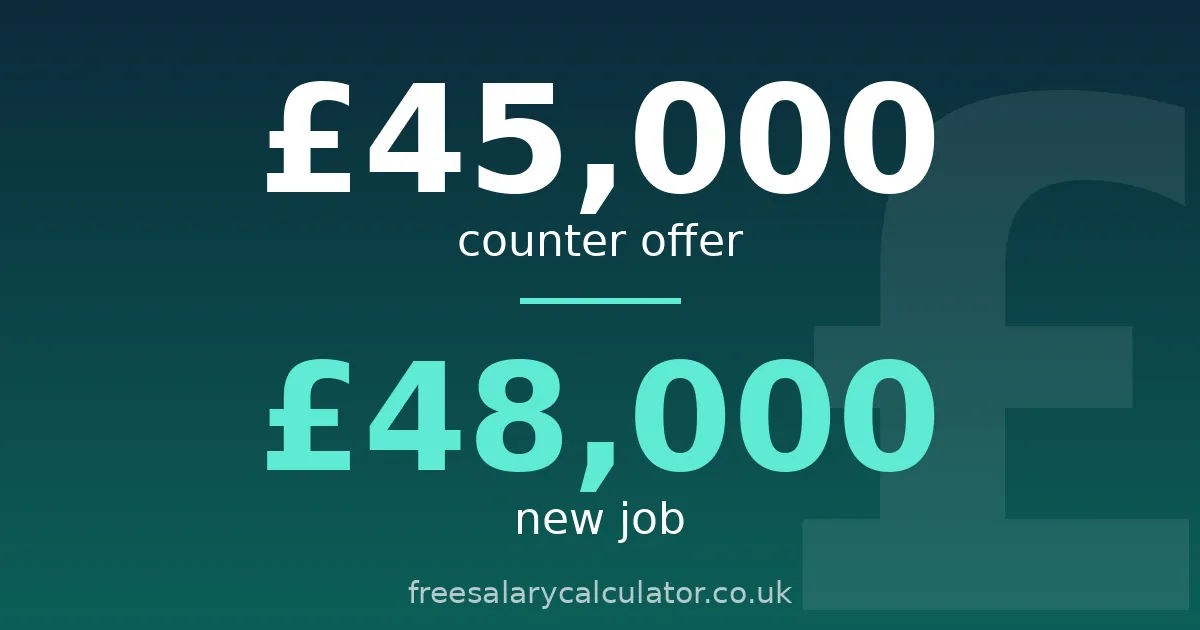
A counter offer vs new job after tax comparison starts with take home pay, not the headline salary. On our example, a £45,000 counter offer adds £300 a month to your pay, while a £48,000 new job adds £480. The new job still wins on money alone, but pension, commute and job security can close the gap fast.
How do you work out a counter offer vs new job after tax?
Put both offers through the same maths. Take the gross salary, subtract income tax and National Insurance for the 2026/27 tax year, and compare what is left each month.
The table below does exactly that for someone earning £40,000 today, with a £45,000 counter offer from their current employer and a £48,000 offer from a new employer. All figures use the standard 1257L tax code and no pension or student loan.
| Offer | Income tax a year | National Insurance a year | Take home a month |
|---|---|---|---|
| Current job £40,000 | £5,486 | £2,194.40 | £2,693.30 |
| Counter offer £45,000 | £6,486 | £2,594.40 | £2,993.30 |
| New job £48,000 | £7,086 | £2,834.40 | £3,173.30 |
The counter offer adds £300 a month to your pay. The new job adds £480 a month. The gap between the two offers is £180 a month, or £2,160 a year, even though the gross salaries differ by £3,000.
That is because both salaries sit in the basic rate band, where every extra pound is taxed at 20% income tax plus 8% National Insurance, so you keep 72p of each extra pound. To compare a counter offer vs new job after tax properly, always start from this monthly take home gap, then add the pension, the commute and the rest of the package.
You can run your own two salaries through our salary comparison tool and see the same breakdown in seconds. For the full monthly detail on each figure, see our £40,000 after tax, £45,000 after tax and £48,000 after tax pages.
Why does the pension change the answer?
Your employer pension contribution is real money, even though it never lands in your bank account. In our example the current employer pays 5% of your full salary into your pension. On a £45,000 counter offer that is £2,250 a year.
The new employer pays the auto enrolment minimum of 3%, and only on qualifying earnings between £6,240 and £50,270. On a £48,000 salary the qualifying earnings are £41,760, so 3% comes to £1,252.80 a year. That is £997.20 a year less pension than the counter offer gives you.
Add the pension to the salary and the picture changes. The counter offer package is £45,000 salary plus £2,250 pension, which is £47,250 a year. The new job package is £48,000 salary plus £1,252.80 pension, which is £49,252.80 a year.
The £2,002.80 gap between those two packages mixes two different kinds of money, salary you take home after tax and pension money paid before tax. Counted properly, the new job pays £2,160 a year more after tax and £997.20 a year less into your pension, so the true gain is £1,162.80 a year, not the £3,000 the headline salaries suggest. Under the auto enrolment rules the legal minimum is 3% from your employer and 5% from you, 8% in total, but many employers pay far more. Always ask both employers what percentage they pay, and whether it applies to your full salary or only to qualifying earnings, because the answer can be worth more than a thousand pounds a year.
What does the commute cost you?
Money is only half the comparison. Time and travel costs are the other half, and a new job often adds both. Suppose the new job needs you in the office three days a week, with a one hour round trip and £6 a day in fares.
Over 46 working weeks that is 138 hours a year spent travelling and £828 a year in fares, which is about £69 a month. That £69 a month eats more than a third of the £180 a month extra the new job pays over the counter offer.
The hours matter as much as the fares. On a 37.5 hour week the new job pays £19.53 an hour after tax, while the counter offer pays £18.42 an hour after tax. But the commute hours are unpaid, so the real hourly rate on the new job is lower once you count them.
Look at it this way: the new job pays £2,160 a year more than the counter offer, and it costs 138 hours of your year in travel. That works out at about £15.65 an hour for time you would otherwise have free.
If the new job also means fewer days working from home, less flexible hours or a longer probation, weigh those too. A counter offer vs new job after tax decision that ignores the commute is not a fair comparison.
How do the tax bands change the maths?
Both salaries in our example sit in the basic rate band, which runs up to £50,270. Above that point the maths changes, because extra income is taxed at 40% income tax plus 2% National Insurance, so you keep only 58p of each extra pound.
Imagine the new job offered £52,000 instead of £48,000. That extra £4,000 a year would add only £219.82 a month to your take home pay, because £1,730 of it falls above the £50,270 threshold and is taxed at the higher rate.
Your student loan can change the answer too. With a Plan 2 loan you repay 9% of earnings above £29,385. On £40,000 that is £79.61 a month, and on £48,000 it is £139.61 a month, so £60 a month of the new job gain goes straight to your loan.
Above £100,000 the maths changes again, because you start to lose your personal allowance. The lesson is the same at every level: a counter offer vs new job after tax comparison has to follow the tax bands, the pension and the loan together, because each one takes a slice of the headline rise.
How do you decide between a counter offer and a new job?
Work through these five steps before you answer either employer, so your counter offer vs new job after tax decision rests on real numbers. They take less than an hour and they stop you choosing on the headline salary alone.
- Run both salaries through our salary comparison tool and write down the monthly take home gap.
- Ask both employers for their pension percentage and whether it applies to your full salary or only to qualifying earnings, then add the employer pension to each salary.
- Price the commute in pounds and hours. Multiply the daily fare and the daily travel time by your working weeks in the year.
- Compare the rest of the package: annual leave days, working from home days, probation length, notice period and any bonus. A bonus that depends on company results is worth less than the same amount as guaranteed salary.
- Once you start, check your first payslip. Confirm your tax code is 1257L and that the pension and student loan deductions match what you agreed. If you know the monthly take home pay you need, our reverse salary calculator works backwards to the gross salary to ask for.
Frequently asked questions
Is a counter offer ever better than a new job after tax?
Yes, often. If the new job pays £180 a month more but adds a long commute and a smaller pension, the counter offer can leave you better off overall. Always compare the full package in a counter offer vs new job after tax choice, not the salary alone.
How much of a pay rise do you actually keep?
In the basic rate band you keep 72p of each extra pound after 20% income tax and 8% National Insurance. Above £50,270 you keep 58p, because the extra income is taxed at 40% plus 2% National Insurance.
Should you tell your current employer about the new offer?
Only if you would genuinely stay for the right counter offer. Tell them the figure you need and the date you must answer by, and keep the conversation calm and factual. If you have already decided to leave, thank them and move on.
Does a counter offer affect your pension?
Yes, in a good way. A higher salary usually means a higher pension contribution from your employer, because the percentage applies to the new salary. Check whether your employer contribution is based on your full salary or only on qualifying earnings.
The verdict
On money alone the new job wins in our example, by £180 a month after tax, and by £1,162.80 a year once the smaller employer pension is counted. But a counter offer vs new job after tax choice is never about money alone.
Price the pension, the commute and the working week, then choose the offer that leaves you better off in total, not just the one with the bigger headline number. If you want to test your own two offers, run them through our salary comparison tool and compare the monthly take home pay side by side. For tips on the conversation itself, read our guide on how to negotiate a job offer salary.