
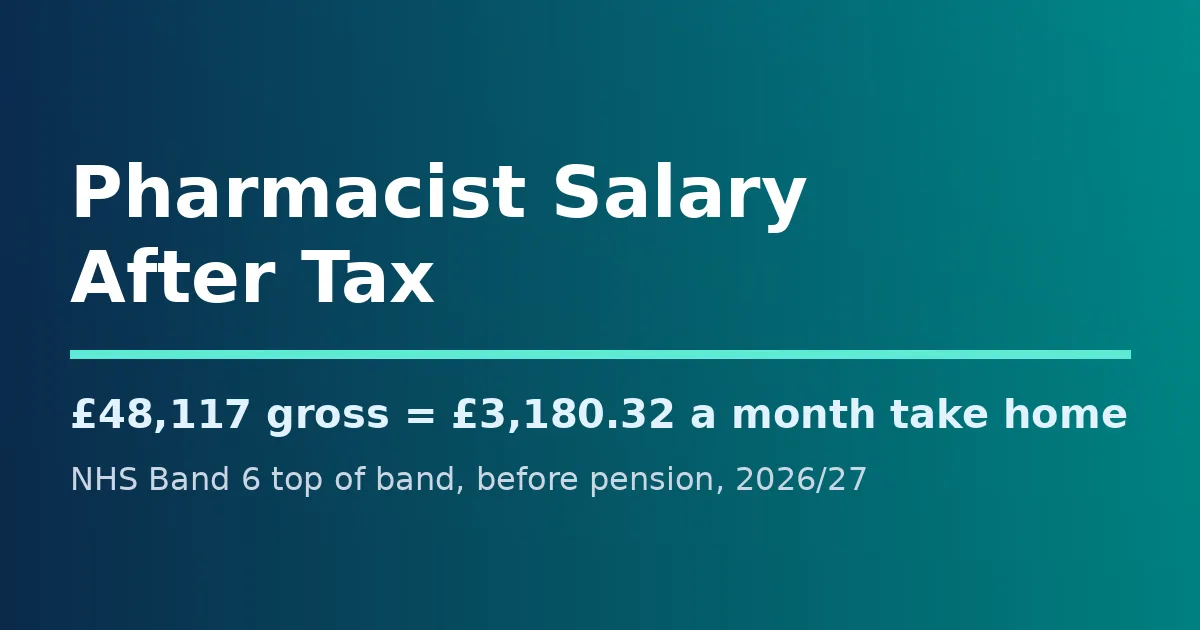
The offer letter says £48,117, and that is the number most pharmacists fix on first when they ask what pharmacist salary after tax looks like. It is the top of NHS Band 6, and pharmacist salary after tax on that point is £3,180.32 a month, before pension and student loan. The tax slice is £7,109.40 of income tax and £2,843.76 of National Insurance, leaving £38,163.84 a year. But hospital pay is only half the story here: community pharmacy negotiates its own rates, and this guide covers both, step by step through Band 6 and out into the high street.
If you are weighing up a pharmacy job offer, the gross salary on the advert is only the starting point. Tax and National Insurance take a fixed slice before you see a penny, and the NHS pension takes another slice for hospital pharmacists.
This article uses England, Wales and Northern Ireland tax rates for 2026/27: a personal allowance of £12,570, basic rate tax of 20 percent up to £50,270, and National Insurance of 8 percent between £12,570 and £50,270. Scotland has its own income tax rates, so Scottish pharmacists will see slightly different take home pay on the same gross salary.
What does an NHS pharmacist earn before tax?
Most hospital pharmacists in England are paid under Agenda for Change, the national pay system for NHS staff. Newly qualified hospital pharmacists usually start at Band 6, and they move up the band as they gain experience. The 2026/27 Band 6 rates published by NHS Health Careers are £39,959 at entry, £42,170 at the intermediate step, and £48,117 at the top of the band, for a full time 37.5 hour week, and they are the gross starting point for a pharmacist salary after tax calculation.
That band is only the hospital route. Community pharmacists work in high street pharmacies and pharmacy chains, and their pay is negotiated with each employer rather than set by a national band. Community pay depends on the branch, the location, and whether the role includes management duties.
What is the take home pay on each Band 6 step?
Here is pharmacist salary after tax worked out step by step for each 2026/27 Band 6 point, using our verified 2026/27 engine and the same method as our live £40,000 after tax page. These figures are before pension and student loan deductions.
| Band 6 step in 2026/27 | Gross a year | Income tax a year | National Insurance a year | Take home a year | Take home a month |
|---|---|---|---|---|---|
| Entry, under 2 years | £39,959 | £5,477.80 | £2,191.12 | £32,290.08 | £2,690.84 |
| Intermediate, 2 to 5 years | £42,170 | £5,920 | £2,368 | £33,882 | £2,823.50 |
| Top of band, 5 years and over | £48,117 | £7,109.40 | £2,843.76 | £38,163.84 | £3,180.32 |
Look at the jump from entry to the top of the band. Gross pay rises by £8,158 a year, but take home pay rises by £5,873.76 a year. The gap is tax and National Insurance on the extra pay, and it is a useful reminder that a pay rise never lands in full in your bank account.
London weighting changes the picture for pharmacists in the capital. Inner London staff receive a high cost area supplement on top of basic pay, with a maximum payment of £8,746 in 2026/27 according to NHS Health Careers. That supplement is taxable, so it raises the tax bill as well as gross pay.
How does the NHS pension change the picture?
Hospital pharmacists in the NHS Pension Scheme pay a percentage of their pensionable pay into the scheme each month. For 2026/27, the NHS Business Services Authority sets the member rate at 9.8 percent for pensionable pay from £35,156 to £52,778 in England and Wales.
Take the top of band salary of £48,117 as the worked example. A 9.8 percent contribution is £4,715.47 a year. Pension contributions in the NHS scheme are taken before income tax is worked out, so income tax falls to £6,166.40.
National Insurance stays at £2,843.76 because pension contributions do not reduce National Insurance. That leaves £34,391.37 a year, or £2,865.95 a month, after tax, National Insurance and pension.
That gap is why a pharmacist salary after tax quoted without pension can mislead, because £314.37 a month never reaches your bank account. The pension is not lost money, because it builds a defined benefit pension for retirement and your employer also contributes on top. Still, it is money that does not reach your bank account each month, so any honest budget must include it.
What about community pharmacy pay?
Community pay has no published national scale, so a pharmacist salary after tax in community pharmacy is best judged by running the same tax calculation on the offered salary. A community pharmacist on £45,000 in England in 2026/27 pays £6,486 in income tax and £2,594.40 in National Insurance, leaving £35,920 a year or £2,993.30 a month before pension. Our live £45,000 after tax page shows the same breakdown.
On £55,000, the figures are £9,432 in income tax and £3,110.60 in National Insurance, leaving £42,457 a year or £3,538.12 a month before pension. That salary crosses into higher rate tax, because income above £50,270 is taxed at 40 percent.
Community roles usually come with a workplace pension rather than the NHS scheme, and the rate varies by employer. Ask about the employer match before you accept, because two jobs on the same gross salary can leave very different amounts in your pension pot.
Locum pharmacists are a separate case. A locum working self employed must set money aside for income tax and National Insurance through self assessment, so the PAYE figures in this guide do not apply to locum work.
What else comes off your pay?
Student loan repayments are the most common extra deduction for younger pharmacists. Under Plan 2, you repay 9 percent of earnings above £29,385 a year. On the top Band 6 salary of £48,117, that is £1,685.88 a year, or £140.49 a month, on top of tax, National Insurance and pension.
That is why a pharmacist salary after tax on paper can differ from the payslip in your hand. Always subtract pension and student loan before you budget.
Other deductions depend on your own circumstances. Union subscriptions, professional indemnity cover, and any salary sacrifice arrangement for extra pension or childcare will each reduce your monthly pay. Salary sacrifice is covered in our salary sacrifice pension guide, and it changes the tax calculation because the sacrificed amount is not treated as salary.
Your tax code matters too. Most pharmacists are on the standard 1257L code, which reflects the £12,570 personal allowance. If your code is different, because of a second job or a taxable benefit, your monthly take home pay will differ from the figures here even on the same salary.
A quick check of the tax code box on your payslip can explain a surprising payslip.
How do you check your own payslip?
Start with your gross pay for the month, multiply it by 12, then compare it with the band or offer letter. Next, check that income tax and National Insurance match the annual figures divided by 12. If either figure is far out, the cause is usually a tax code change or a student loan starting or stopping.
- Confirm your gross annual salary matches your contract or band point.
- Check your tax code is 1257L unless you have a reason for a different code.
- Confirm your pension deduction matches your scheme and your actual pay.
- Check whether a student loan deduction has started, stopped, or changed.
- Use our homepage calculator to rerun your exact salary and compare the result.
Is pharmacy pay good compared with other graduate careers?
Pharmacy pay compares well with many graduate careers at the same stage, because Band 6 entry pay of £39,959 is already above the typical graduate starting salary. Progression to the top of Band 6 and then to Band 7 brings a clear pay ladder, which is not true of every profession.
For a pharmacist salary after tax at Band 7 level, the same method applies: apply the 2026/27 tax and National Insurance rates, then subtract pension and student loan. Our £50,000 after tax page is a useful nearby reference, because Band 7 pay sits around that level. The salary tables page lets you compare any salary from £10,000 to £200,000 in one place.
In short, a pharmacist salary after tax depends on your band or offered salary, your pension scheme, and your student loan. Run your exact salary through a calculator before you accept an offer, and check the first payslip against the result.
Frequently asked questions
How much does an NHS Band 6 pharmacist take home each month?
Before pension and student loan, an NHS Band 6 pharmacist in England takes home £2,690.84 a month at entry, £2,823.50 at the intermediate step, and £3,180.32 at the top of the band in 2026/27. After the 9.8 percent NHS pension contribution, the top of band figure falls to £2,865.95 a month.
Does the NHS pension reduce take home pay a lot?
Yes, by a noticeable amount each month, but it builds a valuable retirement pension and your employer contributes on top. On £48,117, the cash cost after tax relief is £314.37 a month against the before pension figure.
Do community pharmacists earn more than NHS pharmacists?
Sometimes, but not always. Community pay is negotiated per job, so a manager in a busy branch can earn more than a Band 6 hospital pharmacist. Compare the full package, including pension and working hours, not just the headline salary.
How much tax does a pharmacist pay on £48,117?
Take the top Band 6 point and the tax bill is £7,109.40 of income tax plus £2,843.76 of National Insurance, which is £9,953.16 a year between them, before pension. What is left is £38,163.84 a year, or £3,180.32 a month, and that is the figure to budget on, not the £48,117 headline.