
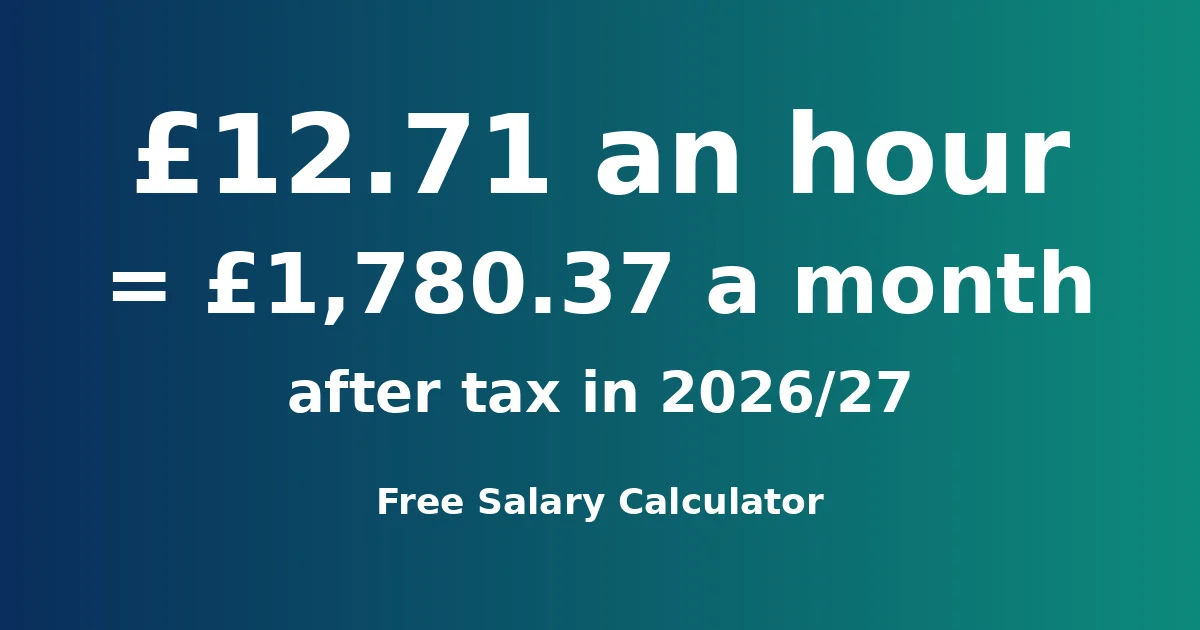
National living wage after tax is £1,780.37 a month on a 37.5 hour week in 2026/27, after £2,442.90 income tax and £977.16 National Insurance. On a 40 hour week the rate gives £1,879.51 a month. This guide shows hours patterns, plus pension and student loan effects.
The hourly rate makes the news, but the monthly bank balance is what matters when rent and bills are due. Tax and National Insurance take a slice before pay reaches you, so £12.71 an hour never means £12.71 in your pocket.
How much is the National Living Wage in 2026/27?
From 1 April 2026 the National Living Wage is £12.71 an hour for workers aged 21 and over, set by the government on the advice of the Low Pay Commission. It rose by 50p from £12.21, a 4.1 percent increase. These are the rates behind every national living wage after tax figure in this guide.
| Worker | Hourly rate from 1 April 2026 |
|---|---|
| Aged 21 and over | £12.71 |
| Aged 18 to 20 | £10.85 |
| Under 18 | £8.00 |
| Apprentice | £8.00 |
Younger workers get lower legal rates, and apprentices in their first year get the apprentice rate whatever their age. The rates change every April, so always check the current year before you rely on a figure. From 1 April 2027 the National Living Wage is due to rise to £13.21 an hour, a 3.9 percent increase announced at the Autumn Budget on 28 October 2026 and covered in our news post on the rise, but until then £12.71 is the rate employers must pay, with the official rates published by GOV.UK.
What does £12.71 an hour pay over a year?
Take the most common full time pattern, 37.5 hours a week for 52 weeks. Gross pay is £12.71 times 37.5 times 52, which is £24,784.50 a year. That is the national living wage after tax starting point, before any deduction comes off.
The first £12,570 is tax free thanks to the personal allowance. Taxable pay is therefore £12,214.50, taxed at the 20 percent basic rate, which gives £2,442.90 income tax. National Insurance is 8 percent of the same £12,214.50, which gives £977.16.
Take home pay is £24,784.50 minus £2,442.90 minus £977.16, which is £21,364.44 a year. That is £1,780.37 a month or £410.85 a week. In other words you keep about 86 percent of gross pay, since only about 14 percent goes in tax and National Insurance at this level.
Scotland works slightly differently, because Scottish income tax bands start lower. On the same £24,784.50 a worker in Scotland pays £2,403.23 income tax and the same £977.16 National Insurance, giving £21,404.11 a year or £1,783.68 a month, as our guide to how UK income tax bands work explains.
How does take home pay change with hours?
Hours change everything, because tax and National Insurance only bite above £12,570. The table below shows national living wage after tax for the hours patterns employers use most, all for 2026/27 with tax code 1257L and no pension or student loan.
| Hours a week | Gross a year | Income tax | National Insurance | Take home a year | Take home a month |
|---|---|---|---|---|---|
| 16 | £10,574.72 | £0 | £0 | £10,574.72 | £881.23 |
| 20 | £13,218.40 | £129.68 | £51.87 | £13,036.85 | £1,086.40 |
| 25 | £16,523.00 | £790.60 | £316.24 | £15,416.16 | £1,284.68 |
| 30 | £19,827.60 | £1,451.52 | £580.61 | £17,795.47 | £1,482.96 |
| 35 | £23,132.20 | £2,112.44 | £844.98 | £20,174.78 | £1,681.23 |
| 37.5 | £24,784.50 | £2,442.90 | £977.16 | £21,364.44 | £1,780.37 |
| 40 | £26,436.80 | £2,773.36 | £1,109.34 | £22,554.10 | £1,879.51 |
| 45 | £29,741.40 | £3,434.28 | £1,373.71 | £24,933.41 | £2,077.78 |
At 16 hours a week gross pay is £10,574.72, below the personal allowance, so no income tax and no National Insurance come off at all. At 20 hours a week a small slice goes in tax and National Insurance, leaving £1,086.40 a month. By 45 hours a week gross pay reaches £29,741.40 and take home pay reaches £2,077.78 a month, though overtime rates in your contract may pay more than the flat rate used here.
Part time workers sometimes assume tax works against them, but the personal allowance applies however few hours you work. If you hold two jobs, the allowance usually sits with your main job only, so check your code on your payslip and compare with our £25,000 after tax breakdown, which shows the same maths on a round salary just above this level.
What happens with a pension or a student loan?
Pension and loan deductions change national living wage after tax, so check both before you compare job offers. A 5 percent salary sacrifice pension on the 37.5 hour pattern puts £103.27 a month into your pension. Take home pay then falls to £1,706.02 a month, a drop of £74.35, while the full £103.27 still goes to your future.
Student loans usually take nothing at this pay level, because full time National Living Wage pay sits below most loan thresholds. Plan 1 starts at £26,900, Plan 2 at £29,385 and Plan 4 at £33,795, so a 37.5 hour worker repays nothing on any of those plans. Plan 5 starts lower, at £25,000, so a 40 hour worker on £26,436.80 repays 9 percent of £1,436.80, which is £10.78 a month.
A postgraduate loan is different again, starting at £21,000 with a 6 percent rate. On the 37.5 hour pattern that means 6 percent of £3,784.50, which is £18.92 a month. Our student loan guide lists every plan threshold if you want to check your own plan.
How does the National Living Wage compare with the real Living Wage?
The real Living Wage is voluntary, worked out by the Living Wage Foundation from actual living costs. From 15 October 2026 it is £14.10 an hour across the UK and £15.45 an hour in London. Employers can choose to pay it, but no law forces them to.
On a 37.5 hour week the UK real Living Wage gives £27,495 gross, with £2,985 income tax and £1,194 National Insurance, leaving £23,316 a year or £1,943 a month. That is £162.63 a month more than the legal minimum on the same hours. In London the £15.45 rate gives £30,127.50 gross and £2,100.95 a month after tax and National Insurance.
How do you check your payslip against the minimum wage?
Use this check whenever national living wage after tax on your payslip looks lower than the table above. First multiply your hourly rate by the hours in the pay period, then compare that figure with gross pay on the payslip. Next check your tax code, since a wrong code can take too much tax during the year.
- Multiply hours worked by £12.71 and compare the result with gross pay for the same period.
- Look for deductions that pull pay down, such as uniform costs or salary sacrifice, since these can leave average hourly pay below the legal floor.
- Check your tax code on the payslip and ask HMRC to correct it if it looks wrong.
- Keep your payslips, so you can show the pattern if a shortfall runs over several months.
If average hourly pay still sits below £12.71 after that check, raise it with your employer first and keep a note of the reply. Most shortfalls turn out to be a payroll error or a wrong tax code, and both can be corrected.
Frequently asked questions
How do I work out national living wage after tax for my own hours?
Multiply £12.71 by your weekly hours and then by 52 to get gross yearly pay. Then take off 20 percent income tax and 8 percent National Insurance on everything above £12,570. Our free calculator does the same maths in seconds if you would rather not work it out by hand.
Is £12.71 an hour enough to live on?
It depends on rent and household size, but £1,780.37 a month on a 37.5 hour week covers a modest budget outside London and the South East. Sharing a home or living with family stretches it much further. In London the real Living Wage of £15.45 an hour is a better benchmark for a single person renting alone.
Do I pay tax on the National Living Wage?
Yes, once pay passes £12,570 a year. On a 37.5 hour week that means £2,442.90 income tax and £977.16 National Insurance in 2026/27. Part time workers under the allowance pay nothing, as the table above shows.
Does the National Living Wage rise every year?
Rates are reviewed every April on Low Pay Commission advice. The rate rose from £12.21 to £12.71 in April 2026, and a rise to £13.21 is already announced for April 2027. Our news post on the April 2027 rise explains what that means for take home pay.
Where can you check your own exact figure?
Now you know what national living wage after tax really means at £12.71 an hour, from £881.23 a month on 16 hours to £2,077.78 a month on 45 hours. Your own figure depends on hours, pension choices and any student loan, so run your exact pattern through our free salary calculator. If you want the wider picture, our salary tables show take home pay at every salary level from £10,000 to £200,000.