Your tax code tells your employer how much of your pay is tax free, and it sits near the top of every payslip. If you searched for tax codes explained uk, this page decodes 1257L, BR, D0, 0T and K, with the exact tax each one takes on £2,500 a month.
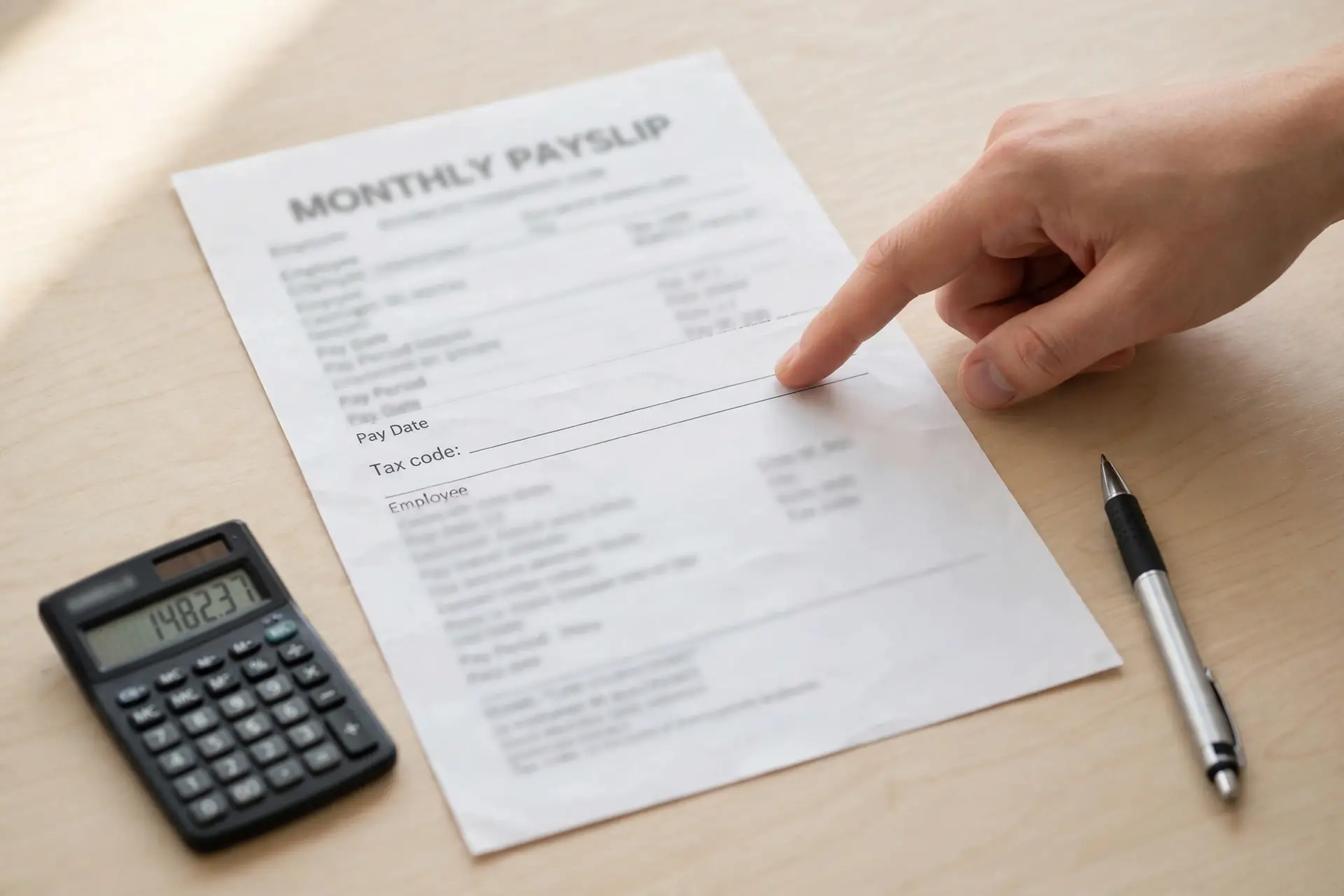
Look near the top of your latest payslip, just under your name and your pay date. You will see a short line that reads Tax code, followed by a few letters and numbers. That short line decides how much tax leaves your pay before the money reaches your bank.
Most people never look at it until the pay in their bank drops for no clear reason. Then BR sits where 1257L used to sit, or a K code has appeared, and nobody at work can explain it. ‘Tax Codes Explained UK’ works through each code with the maths, so you can see what yours is doing to your pay.
All the figures here are for the 2026/27 tax year, from 6 April 2026 to 5 April 2027. The personal allowance, the amount you can earn before income tax starts, is £12,570. Income tax is 20% up to £50,270 a year, 40% up to £125,140, and 45% above that.
Run your own salary through the free salary calculator to see your own numbers beside this guide.
How do you read any tax code in 30 seconds?
Every code in ‘Tax Codes Explained UK’ has two parts, a number and a letter, and each part answers one question. The number tells you how much tax free pay the code gives you, and the letter tells you which rule applies. Once you know that, you can read any code on any payslip.
To get the tax free amount, take the number and add a zero on the end. A code of 1257 means £12,570 of tax free pay a year, because HMRC drops the final zero when it writes the code.
A code with no number at all, such as BR or D0, gives you no tax free pay on that job. HMRC works out the number by starting with your personal allowance of £12,570. It then takes off anything you earn without paying tax on it, plus any other deductions, such as a company car or private medical insurance.
GOV.UK gives one clear example: a medical insurance benefit worth £1,570 takes the allowance down to £11,000, so the code becomes 1100L. Our UK tax codes guide lists every code in one place if you want the full list first.
What does each code cost on the same pay?
The table below puts five codes side by side on the same pay, £2,500 a month, which is £30,000 a year. It is the fastest way to see what your code is costing you. National Insurance is not in the table, because your tax code does not change it, and it stays at 8% on pay between £12,570 and £50,270.
| Code | Tax free pay a month | Taxable pay a month | Tax a month |
|---|---|---|---|
| 1257L | £1,047.50 | £1,452.50 | £290.50 |
| BR | £0 | £2,500 | £500 |
| D0 | £0 | £2,500 | £1,000 |
| 0T | £0 | £2,500 | £500 |
| K300 | None, and £250 added | £2,750 | £550 |
Keep this table in mind as you read on. ‘Tax Codes Explained UK’ puts the five codes side by side in one place, and each code below gets its own section.
What does 1257L mean on your payslip?
1257L is the code most people who search tax codes explained uk will have. It is the code HMRC gives to most people with one job or one pension.
The 1257 stands for £12,570 of tax free pay a year, and the L means you get the standard personal allowance. If you have one job, no company benefits and no other income, this is almost certainly your code. Your employer takes the tax through Pay As You Earn, known as PAYE, which is the system that takes tax from your pay before you receive it.
On a £30,000 salary the maths is simple. Take £12,570 off £30,000 and £17,430 is left to tax.
Income tax at 20% on that is £3,486 a year, and National Insurance at 8% on the same £17,430 is £1,394.40 a year. That leaves £25,119.60 a year, or £2,093.30 a month, in your bank.
Your tax is worked out on a cumulative basis, which means payroll looks at your pay so far this tax year, not just this month. If too much tax came off in an early month, payroll usually puts it back in a later month on its own. That is why a 1257L payslip can show a smaller tax line after a quiet month, and it is nothing to worry about.
When does BR appear, and what does it cost?
BR is the code for a second job or a second pension, and most people who searched for tax codes explained uk meet it after 1257L. It taxes every pound from that job at the basic rate of 20%, with no tax free pay at all. HMRC uses it because your personal allowance is already used up on your main job.
On a second job paying £2,500 a month, BR takes £500 a month in tax. That is correct if your main job already uses your full £12,570 allowance. If BR appears on your only job, it is wrong, and you are paying tax you do not owe.
BR is not an emergency code, even though some guides call it one. It stays until your circumstances change. Our BR tax code second job guide works through the second job maths in full, including the case where BR is wrong.
What about D0 and D1?
D0 and D1 work like BR, but at higher rates, and they appear on a second job or pension when your main income already fills the lower bands. They belong together because the maths is the same shape, only the rate changes, and ‘Tax Codes Explained UK’ covers them together for that reason. D0 taxes every pound at the higher rate of 40%, and D1 taxes every pound at the additional rate of 45%.
On the same £2,500 a month, D0 takes £1,000 a month in tax, twice what BR takes. D1 would take £1,125 a month.
These codes usually appear when a main job already pays more than £50,270 a year, so the second income sits in the higher band from the first pound. If your main job pays less than that, a D0 code is worth questioning.
Why would you see 0T?
0T means you get no tax free pay on this job, and it appears when HMRC has no details to give you a proper code. That usually happens because you started a new job and your employer has no P45 from you.
A P45 is the form your old employer gives you when you leave, showing your pay and tax so far this year. Without it, HMRC cannot see your record, so it issues 0T as a holding code.
On £2,500 a month, 0T takes £500 in the first month, the same as BR at this pay, but for a different reason. BR means your allowance is used on another job.
0T means HMRC has no details at all, so it gives you no allowance anywhere. That is why 0T is the code to chase: it should change once HMRC gets your details.
At higher pay, 0T costs more than BR, because each slice is taxed at the rate that applies. Pay above £50,270 a year is taxed at 40% up to £125,140. If you searched for tax codes explained uk because 0T is still on your payslip after a month or two, the fix steps sit in the last section.
What is a K code, and why does it hurt twice?
A K code is the one that shocks people most, and it deserves its own section, so ‘Tax Codes Explained UK’ gives it one here. It appears when you have income that is not taxed anywhere else, and that income is worth more than your personal allowance.
The usual causes are a company car or private medical insurance. A State Pension collected through your pay, or tax you underpaid in an earlier year, can do it too.
A K code works backwards from every other code. Instead of giving you tax free pay, it adds extra income to your pay and taxes the total. The number tells you how much is added: K300 adds £3,000 a year, or £250 a month, to the pay your employer taxes.
A benefit in kind is a perk from your job that counts as pay for tax, such as a company car or private medical insurance. Here is the double hit, worked on a £20,000 salary with a K300 code.
Your employer taxes you as if you earned £23,000, so the tax is 20% of £23,000, which is £4,600 a year. On the standard 1257L code the same salary would be taxed on £7,430, which is £20,000 less £12,570, and the tax would be £1,486 a year.
The K code costs an extra £3,114 a year, or £259.50 a month. Check it another way: the swing is the £12,570 allowance lost plus the £3,000 added, which is £15,570. Tax at 20% on £15,570 is £3,114, the same answer.
The number is built the same way as 1257. A company car worth £10,900 plus £4,500 of underpaid tax is £15,400, which is £2,830 over the allowance, so the code is K283.
HMRC caps the tax at half your pay before tax in any single pay period, so the tax line can never eat your whole wage. If your K code looks wrong, check the benefit or the underpayment behind it first, because the code is only the messenger. Our emergency tax code refund guide covers the case where a wrong code has already taken too much.
Why does your code start with S or C?
If your code starts with S or C, the first letter tells you which nation sets your rates, and the rest of the code works the same way. Scotland and Wales have their own codes, and the letters at the end change too, which is why people who typed tax codes explained uk into Google land here. S is Scotland, and C is Wales, from Cymru, the Welsh name for Wales.
Scotland sets its own income tax bands, so it has four D codes instead of two. SD0 taxes all the income at the intermediate rate of 21%, and SD1 at the higher rate of 42%. SD2 taxes all the income at the advanced rate of 45%, and SD3 at the top rate of 48%.
Wales uses the same rates as England, so its codes are simpler: CBR, CD0 and CD1 match BR, D0 and D1 exactly. A code of C1257L in Wales means the same as 1257L in England. If you move between nations, your code should change with you, so check it after a move.
How do you spot an emergency code?
These three endings mark an emergency code, and they are added to the end of your normal code, for example 1257L M1. W1 is for weekly pay, M1 is for monthly pay, and X is used when your pay dates vary, while some payroll software shows NONCUM instead. Treat these endings as a warning light, not a final code, and that warning is the point of ‘Tax Codes Explained UK’.
An emergency code taxes each payday on its own, instead of looking at your pay so far this year. That is the non cumulative basis, which means each week or month stands alone, with no catch up for earlier months. You usually land on one after starting a new job, and HMRC updates it once your details arrive.
HMRC usually updates the code within 35 days of you starting, once it has your details from your new employer and your old one. If too much tax was taken while the emergency code was in use, the overpayment usually comes back through your pay once the new code is in place.
What about the M, N, T and NT letters?
M and N are the marriage allowance letters, and they move £1,260 of one partner’s personal allowance to the other. That transfer is worth up to £252 a year in tax saved at the basic rate. A code of 1383M gives £13,830 of tax free pay, which is £12,570 plus £1,260, while 1131N gives £11,310, which is £12,570 less £1,260.
T means HMRC has used other calculations to work out your allowance, often because it is split between two sources of income. It is a sign that your code needed extra working, not a rate on its own. Marriage allowance has a full guide of its own coming on this site, so this section stays short for anyone who looked up tax codes explained uk.
NT is the last letter worth knowing. It means no tax is taken on that income at all, which usually applies when the income is taxed elsewhere or you have no tax to pay on it.
What should you do if the code looks wrong?
Start by checking the code online, in your Personal Tax Account on GOV.UK or in the HMRC app, where you can also see why HMRC chose it. If the details HMRC holds are wrong, update them there first, because that is the fastest route to a new code. Your employer cannot change your code, so ringing payroll will not fix it.
HMRC says it will tell you and your employer the new code within 15 working days of the change. If you are paid monthly, the new code should appear on your next payslip or the one after. If you are paid weekly, it should appear on your third payslip.
If you have just started a new job, wait 35 days before you ring HMRC. That is how long HMRC usually takes to get your details from your new employer and your old one. If you have paid too much tax, the overpayment usually comes back through your pay once the new code is in use.
Our payslip explained UK guide shows how to check each line once the new code lands.
Your tax code is a short string, but it moves real money every month, and now you can read it. Keep ‘Tax Codes Explained UK’ beside your next payslip and check the maths in the table above. If the numbers do not match, you know where to look, and how long the fix should take.
Every rate and threshold in ‘Tax Codes Explained UK’ is from GOV.UK, HMRC or the Scottish Government for 2026/27, including the tax code guidance. The worked examples use those rates, with the arithmetic shown. This is general information, not personal tax advice, and if your situation is unusual, HMRC can confirm the right code for you.
Common questions
What is the most common tax code in the UK?
1257L is the most common code, giving £12,570 of tax free pay a year in 2026/27. It applies to most people with one job or one pension and no company benefits.
How do I work out what my tax code means?
Take the number, add a zero, and that is your tax free pay for the year, so 1257 means £12,570. The letter tells you which rule applies, and the table near the top puts the main codes side by side for anyone who searched for tax codes explained uk. If the letter is K, the number is extra income added to your pay instead.
Why is my tax code BR on my second job?
BR is correct on a second job when your main job already uses your full personal allowance. It taxes every pound from the second job at 20 percent, with no tax free pay. If BR appears on your only job, it is wrong, so check your details with HMRC.
What does a K code mean for my pay?
A K code means HMRC is taxing income that is not taxed anywhere else, such as a company car, through your pay. The number times ten is the extra income added, so K300 adds £3,000 a year. Your employer cannot take more than half of your pay before tax in any one pay period.
How long does it take HMRC to fix a wrong tax code?
HMRC says it will tell you and your employer the new code within 15 working days. Monthly pay should show it on the next payslip or the one after, and weekly pay on the third payslip. If you have just started a new job, wait 35 days before you contact HMRC.
Do I pay tax on a 0T code?
Yes, 0T taxes all of your pay from that job, with no tax free allowance. Each slice is taxed at its own rate, so pay up to £50,270 a year is taxed at 20 percent and pay above that at 40 percent up to £125,140. 0T is usually a holding code, so it should change once HMRC gets your details.