
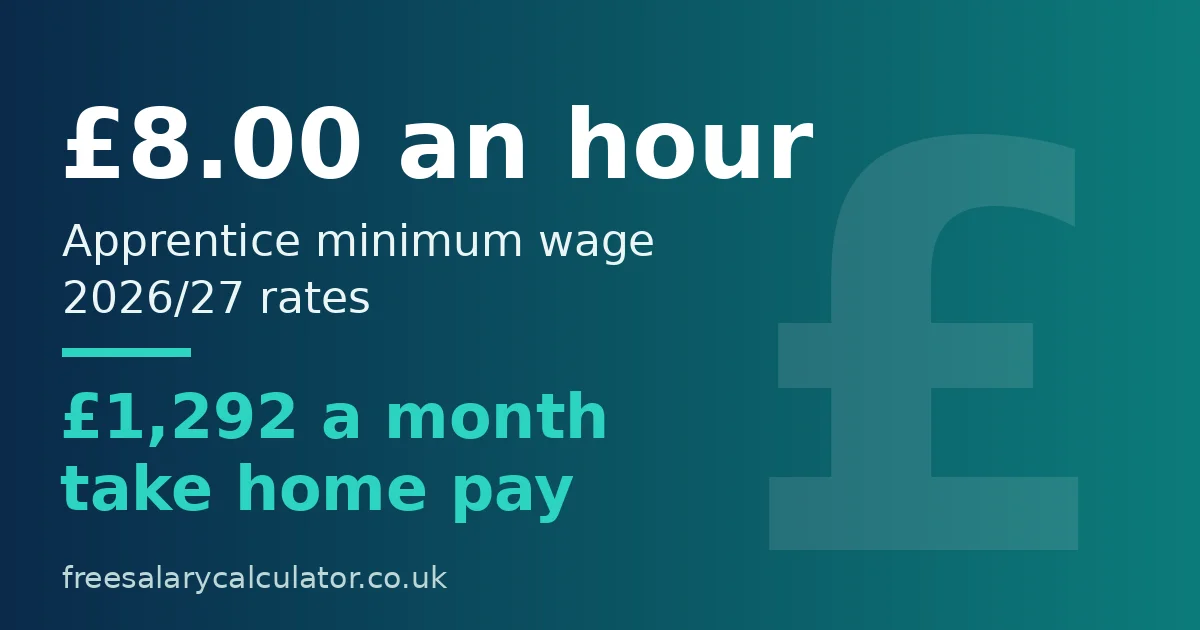
Apprentice pay after tax is £1,292 a month on a 40 hour week at the 2026/27 apprentice rate of £8.00 an hour. That is £15,500 a year after income tax and National Insurance, from £16,640 gross. Shorter weeks can mean no tax at all, and your pay must rise after year one if you are 19 or over.
What is the apprentice minimum wage in 2026/27?
The apprentice rate is £8.00 an hour from 1 April 2026. The government set the rate after accepting the Low Pay Commission recommendations in full, and it applies across England, Scotland, Wales and Northern Ireland. It is up 45p on the previous rate of £7.55, a rise of 6.0%.
The rate is a legal floor, not a typical wage. Many employers pay more, and your contract may promise a higher hourly rate than the legal minimum. What the law sets is the lowest your employer can pay you, and paying below it is a breach of minimum wage law.
Who gets the £8.00 rate depends on your age and how far into the apprenticeship you are. The rule has two routes in, and one clear exit.
| Your situation | Minimum hourly rate |
|---|---|
| Under 19, any year of the apprenticeship | £8.00 |
| 19 or over, in the first year | £8.00 |
| 19 or 20, in year two or later | £10.85 |
| 21 or over, in year two or later | £12.71 |
GOV.UK gives a direct example: an apprentice aged 21 in the first year is entitled to £8.00 an hour, while an apprentice aged 21 who has completed the first year is entitled to £12.71. Age alone does not decide your rate, and neither does the year alone, so both facts together decide it.
How much is apprentice pay after tax on every hours band?
This table shows apprentice pay after tax at the £8.00 rate for the four most common working weeks. It assumes 52 paid weeks a year, the standard 1257L tax code, no pension contributions and no student loan. It uses the 2026/27 personal allowance of £12,570, income tax at 20% above it, and employee National Insurance at 8% above it.
| Hours a week | Gross a year | Income tax | National Insurance | Take home a year | Take home a month |
|---|---|---|---|---|---|
| 30 hours | £12,480 | £0 | £0 | £12,480 | £1,040 |
| 35 hours | £14,560 | £398 | £159 | £14,003 | £1,167 |
| 37.5 hours | £15,600 | £606 | £242 | £14,752 | £1,229 |
| 40 hours | £16,640 | £814 | £326 | £15,500 | £1,292 |
Figures are rounded to the nearest pound, so a row may differ by £1. The figures cover England, Wales and Northern Ireland, since Scotland sets its own income tax bands. Run your own hours and rate through our free UK salary calculator if your week is not in the table, and it will show your apprentice pay after tax in seconds.
On a 30 hour week you keep every pound you earn. Your gross pay of £12,480 sits below the personal allowance of £12,570, so no income tax is due and no National Insurance is due either. That is why apprentice pay after tax can be the same as gross pay on shorter weeks, a point the rival guides skip.
Why do some apprentices pay no tax at all?
There is no apprentice exemption from tax, so apprentices pay income tax and National Insurance on exactly the same basis as any other employee, through PAYE, before the money reaches their bank account. The reason many apprentices pay nothing is simpler than that. Their annual pay falls below the thresholds where tax starts.
The personal allowance is £12,570 for 2026/27. You pay no income tax on earnings up to that figure, and 20% on earnings above it up to £50,270. An apprentice on £8.00 an hour for 30 hours a week earns £12,480 a year, which is £90 below the allowance, so the tax bill is zero.
National Insurance starts at the same annual figure of £12,570 for employees, at 8% on earnings above it up to £50,270. The same 30 hour apprentice pays no National Insurance either, for the same reason. At 35 hours the apprentice earns £14,560, which is £1,990 above the threshold, so income tax is £398 and National Insurance is £159.
Our £15,000 after tax breakdown is the closest ready made check for the 37.5 hour apprentice salary of £15,600, and our UK income tax guide sets out the bands and the personal allowance in full.
What happens to apprentice pay after the first year?
The first year anniversary is the most important date in any apprenticeship, because it decides your apprentice pay after tax for the rest of the programme. Once you have completed your first year and you are aged 19 or over, the apprentice rate no longer applies, and your employer must move you to the National Minimum Wage rate for your age band. The rise is automatic, and you do not have to ask for it.
Here is apprentice pay after tax once the age rate applies, on the same basis as the table above, with the standard 1257L tax code and no pension or student loan deductions.
| Your rate in year two | Hours a week | Gross a year | Income tax | National Insurance | Take home a year | Take home a month |
|---|---|---|---|---|---|---|
| £10.85, aged 19 to 20 | 37.5 hours | £21,158 | £1,718 | £687 | £18,753 | £1,563 |
| £10.85, aged 19 to 20 | 40 hours | £22,568 | £2,000 | £800 | £19,769 | £1,647 |
| £12.71, aged 21 or over | 37.5 hours | £24,785 | £2,443 | £977 | £21,364 | £1,780 |
| £12.71, aged 21 or over | 40 hours | £26,437 | £2,773 | £1,109 | £22,554 | £1,880 |
The jump is large. A 21 year old on a 40 hour week goes from £15,500 take home a year on the apprentice rate to £22,554 on the National Living Wage, a rise of £7,054 a year, or £588 a month. A 19 year old on the same hours goes from £15,500 to £19,769, a rise of £4,269 a year, or £356 a month.
A common mistake is to assume that finishing year one means jumping straight to £12.71, but it does not. Age still decides which band you move into, so a 19 year old moves to £10.85 and waits for the £12.71 rate until age 21. Our minimum wage vs living wage guide compares all four statutory rates side by side, with take home figures for each one.
If your anniversary has passed and your pay has not risen, that is a minimum wage breach, not a pay review you have to negotiate. Raise it with your employer first, since many cases are payroll errors, and if that does not fix it, report it to HMRC.
Worked example: a degree apprentice on £24,000
Not every apprentice earns the legal minimum. Degree apprenticeships and higher apprenticeships often pay a salary, and £24,000 a year is a typical figure for a degree apprentice in a large employer programme. Degree apprentice pay after tax looks very different from the minimum rate example, and it shows how the thresholds bite once pay rises.
On £24,000 gross, income tax is 20% of the £11,430 above the personal allowance, which is £2,286 a year. Employee National Insurance is 8% of the same £11,430, which is £914 a year. Take home pay is £20,800 a year, or £1,733 a month, before any pension contribution.
With a 5% workplace pension contribution on qualifying earnings, the picture changes. Qualifying earnings are the slice of pay between £6,240 and £50,270, so on £24,000 the pension is 5% of £17,760, which is £888 a year. Take home pay falls to £19,912 a year, or £1,659 a month.
Degree apprentices have one advantage over graduates on the same salary: they do not take out a student loan, because the employer and the government fund the degree, so there is no 9% Plan 2 student loan deduction on earnings above the repayment threshold. A graduate on £24,000 repays nothing a month on a student loan under Plans 1, 2, 4 or 5, because £24,000 is below every one of those repayment thresholds. The only loan that takes anything at this salary is a postgraduate loan, and that is £15 a month at most. Our £25,000 after tax breakdown is the closest ready made check for a £24,000 degree apprentice salary.
Do apprentices pay pension contributions?
Apprentices are covered by the same workplace pension rules as other workers. If you are aged 22 or over and you earn more than £10,000 a year, your employer must enrol you in a workplace pension scheme, and you must be given the choice to opt out rather than having to opt in. If you are under 22, or you earn less than £10,000, you can ask to join, and your employer must let you.
Pension contributions change apprentice pay after tax by a small but real amount. The minimum employee contribution is 5% of qualifying earnings, which are the slice of pay between £6,240 and £50,270, not the whole salary. Your employer pays at least 3% on top.
On the full time apprentice salary of £16,640, qualifying earnings are £10,400, so the 5% employee contribution is £520 a year. Take home pay falls from £15,500 to about £14,980 a year, or from £1,292 to about £1,248 a month. The exact figure depends on whether your scheme takes the contribution before tax or after it, so treat the monthly figure as close rather than exact.
What counts as paid working time for an apprentice?
Your minimum wage entitlement covers every hour you are required to work or attend training, not just the hours you spend at your employer’s workplace. This is the rule apprentices most often lose money on, because college days and training days are sometimes treated as unpaid, and they are not. Those paid hours decide your apprentice pay after tax, so an unpaid training day would cut your take home pay directly.
At least 20% of your apprenticeship must be off the job training, which means learning away from your normal day to day work. That time includes college days, online learning, mentoring sessions and time spent writing up your portfolio. All of it must be paid at your normal rate, and it counts towards your paid hours for the week.
Travel time counts too, in one case and not in the other. Travel between two work sites for the same employer counts as working time and must be paid. Ordinary travel from home to your normal workplace does not count, and neither do rest breaks during the working day.
Tips and service charges do not count towards the minimum wage, so your base rate must meet £8.00 before tips are added. Deductions for uniforms, tools or till shortages must not take your pay below the minimum wage either.
Why do employers like hiring apprentices?
There is a tax reason employers recruit apprentices, and it is worth knowing because it explains why many apprentices are paid above the £8.00 minimum. Employers pay no employer National Insurance on apprentices under 25, on earnings up to £50,270 a year, so on a salary of £1,300 a month a standard employee costs the employer about £132 a month in employer National Insurance, while an apprentice under 25 costs nothing. The apprentice still pays their own employee National Insurance as usual, and only the employer side is relieved.
What changes in April 2027?
Apprentice pay after tax rises with the rate in April 2027. The Low Pay Commission announced its recommendations on 28 October 2026, and the government accepted them in full. From 1 April 2027 the apprentice rate rises to £8.31 an hour, up 31p, or 3.9%.
On a 40 hour week, £8.31 an hour pays £17,285 gross a year. Income tax on that figure is £943 and National Insurance is £377, leaving take home pay of £15,965 a year, or £1,330 a month. That is £465 a year more in your pocket than the current £15,500, or £39 a month more.
The other rates rise at the same time. The National Living Wage for workers aged 21 and over rises to £13.21 an hour, the 18 to 20 rate rises to £11.27, and the 16 to 17 rate rises to £8.31, the same as the apprentice rate. Check the official rates on the GOV.UK National Minimum Wage rates page if you want the full table, including the rates for previous years.
How do you check your apprentice pay is right?
Start with your payslip. Divide your gross pay for the period by the hours you worked in that period, including college days, training time and travel between sites. If the result is below £8.00, or below your age rate in year two, you may be underpaid.
Check your apprentice pay after tax against the table above for your hours band. If the gross figure is right but the take home figure is lower than the table, look at the deductions. A pension contribution, a student loan deduction that should not be there, or an emergency tax code can each explain the gap.
Your tax code matters more in a first job than in any other, and the standard code is 1257L. If your code ends in W1, M1 or X, you are on an emergency code, which taxes each pay period as if it stood alone and can over deduct tax in your first months. It corrects itself by the end of the tax year, but you can fix it faster through your HMRC personal tax account, or by giving your employer your P45 from a previous job.
If the numbers do not add up, raise it with your employer first, since many cases are payroll errors. If that does not fix it, contact ACAS for free advice, and you can report the underpayment to HMRC, which enforces minimum wage law and can order back pay. Employers who underpay can face fines of up to 200% of the underpayment, capped at £20,000 per worker, and can be publicly named.
Frequently asked questions
How much is apprentice pay after tax on 30 hours a week?
On 30 hours a week at £8.00 an hour you earn £12,480 a year gross and you keep all of it, which is £1,040 a month and £240 a week. Your pay sits £90 below the personal allowance of £12,570, so no income tax and no National Insurance is due.
Do apprentices pay tax and National Insurance?
Yes, apprentices pay income tax and National Insurance on exactly the same basis as any other employee, through PAYE. There is no apprentice exemption. You pay 20% income tax and 8% National Insurance on earnings above £12,570 a year in 2026/27.
When does an apprentice move off the £8.00 rate?
When you have completed your first year and you are aged 19 or over. From that date your employer must pay the National Minimum Wage rate for your age, which is £10.85 an hour if you are 19 or 20, or £12.71 if you are 21 or over. Apprentices under 19 stay on £8.00 in every year.
Are college and training days paid?
Yes, all time spent at college or on off the job training must be paid at your normal rate, and at least 20% of your apprenticeship must be off the job training. Travel between two work sites for the same employer also counts as paid working time, while ordinary travel from home and rest breaks do not.
Can an employer pay an apprentice less than £8.00 an hour?
No, £8.00 an hour is the legal minimum from 1 April 2026, and paying below it is a minimum wage breach. Tips, service charges and deductions for uniforms or tools cannot be used to bring your pay below the minimum. You can report underpayment to HMRC, which can order back pay.
The verdict
Apprentice pay after tax starts low, because the legal rate is £8.00 an hour and a full time week takes home £1,292 a month. But the rate is a floor, not a ceiling, and the two dates that matter are your first year anniversary and 1 April 2027, when the rate rises to £8.31.
Check your contract against the table for your hours, check your payslip against the rate for your age and year, and check your tax code on your first payslip. If any of the three is wrong, raise it now, because the money adds up to thousands of pounds over an apprenticeship.