
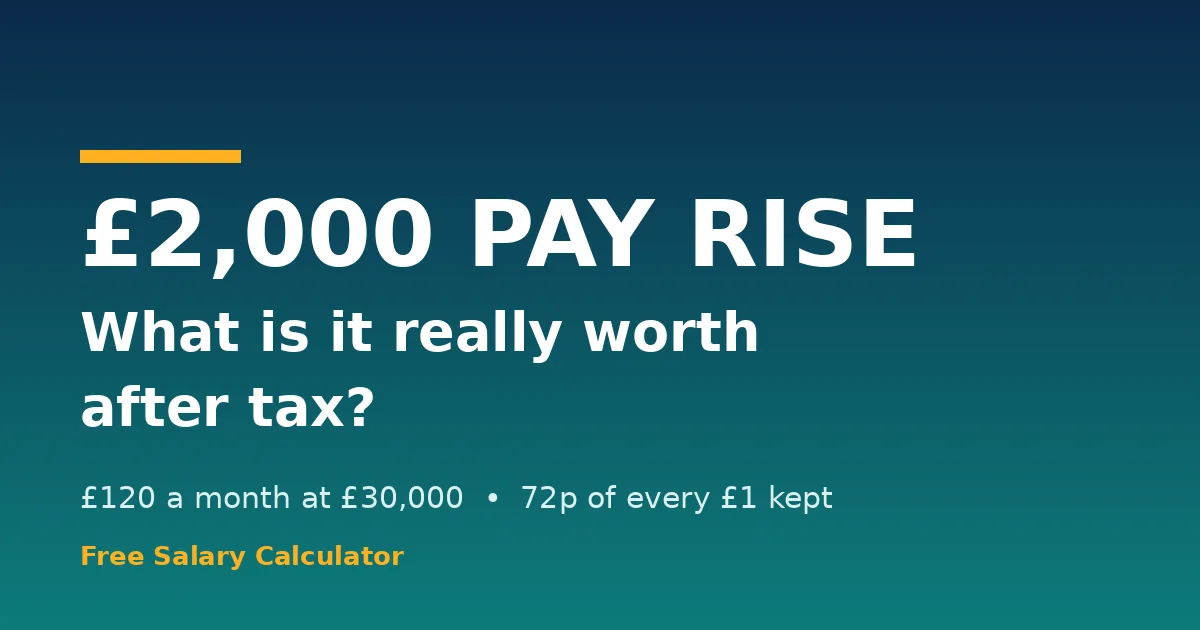
You are sitting across the table with a £2,000 rise on offer, and the question is not whether to take it, it is what a £2,000 pay rise after tax is actually worth. A £2,000 pay rise after tax is worth £1,440 a year, or £120 a month, for a basic rate worker, because you keep 72p of each extra £1 after 20 percent income tax and 8 percent National Insurance. The gain is smaller if the rise crosses a tax band, or if you repay a student loan.
A headline rise sounds simple, but the money that reaches your bank account is a different number. Tax and National Insurance take their share first, and the worked examples below show the difference on real salaries, not just in theory. That is the whole point of working out a £2,000 pay rise after tax on real salaries: the headline and the bank account rarely agree.
All figures use the 2026/27 rules for England, Wales and Northern Ireland, with the standard £12,570 personal allowance and no pension or student loan deduction unless stated. National Insurance is the same across the UK, while income tax bands differ in Scotland. Use it to check a £2,000 pay rise after tax before you accept an offer, rather than after your first payslip arrives.
The £30,000 case: £120 a month, not £166.67
On £30,000 you pay £3,486 in income tax and £1,394 in National Insurance, leaving £25,120 a year, or £2,093.30 a month. That matches the live £30,000 after tax page. On £32,000 you pay £3,886 in income tax and £1,554 in National Insurance, leaving £26,560 a year, or £2,213.30 a month.
The rise adds £400 in income tax and £160 in National Insurance, a total of £560 in extra deductions. That leaves £1,440 a year, or £120 a month, in your pocket. A £2,000 rise on this salary is therefore a £120 a month rise, not a £166.67 a month rise.
| Figure | On £30,000 | On £32,000 | Change |
|---|---|---|---|
| Gross salary | £30,000 a year | £32,000 a year | £2,000 a year |
| Income tax | £3,486 a year | £3,886 a year | £400 a year |
| National Insurance | £1,394 a year | £1,554 a year | £160 a year |
| Take home pay | £25,120 a year | £26,560 a year | £1,440 a year |
The same £120 a month result holds for any £2,000 rise inside the basic rate band. A rise from £40,000 to £42,000 also keeps £1,440 a year, taking monthly take home pay from £2,693.30 to £2,813.30. That is why the rise feels the same in monthly terms wherever it falls inside that band.
Why do you keep 72p of every extra £1?
Your whole salary is not taxed at one rate. Only the slice of pay inside each band is taxed at that band rate, which HMRC calls the marginal rate. A pay rise sits on top of what you already earn, so it is taxed at the marginal rate, not the average rate.
In 2026/27 the basic rate is 20 percent income tax on pay above £12,570 and up to £50,270, and employee National Insurance is 8 percent on the same stretch of pay. Together they take 28p of every extra £1, leaving 72p. On £30,000 the average rate is only 16.3 percent, yet the next pound still costs 28p.
| Pay band in 2026/27 | Income tax | National Insurance | You keep |
|---|---|---|---|
| Up to £12,570 | 0 percent | 0 percent | £1 |
| £12,571 to £50,270 | 20 percent | 8 percent | 72p |
| £50,271 to £100,000 | 40 percent | 2 percent | 58p |
| £100,001 to £125,140 | 60 percent taper | 2 percent | 38p |
| Above £125,140 | 45 percent | 2 percent | 53p |
When the rise crosses £50,270
A rise that crosses the higher rate threshold is worth less, because part of it is taxed at 40 percent instead of 20 percent. On £50,000 you take home £39,520 a year, or £3,293.30 a month, and on £52,000 you take home £40,717 a year, or £3,393.12 a month. A rise that straddles the threshold is therefore worth checking slice by slice.
The gain is £1,198 a year, or £99.82 a month, instead of £1,440 a year. The first £270 stays in the basic rate band and keeps £194.40, at 72p per £1, while the remaining £1,730 falls in the higher rate band and keeps £1,003.40, at 58p per £1. In other words, a £2,000 pay rise after tax near £50,270 is worth less than the same rise at £30,000.
| Slice of the £2,000 rise | Tax and National Insurance | You keep |
|---|---|---|
| First £270, basic rate | 28 percent | £194.40 a year |
| Remaining £1,730, higher rate | 42 percent | £1,003.40 a year |
| Whole £2,000 rise | £802.20 in total | £1,197.80 a year |
This split is the point most guides skip, and it is why a rise near a threshold can disappoint. Test your own numbers with the salary comparison tool. Before you celebrate, work out the rise on your own salary, not on a headline figure.
The £60,000 case
At £60,000 the whole rise sits in the higher rate band, so the gain is smaller. On £60,000 you pay £11,432 in income tax and £3,211 in National Insurance, leaving £45,357 a year, or £3,779.78 a month. On £62,000 you pay £12,232 in income tax and £3,251 in National Insurance, leaving £46,517 a year, or £3,876.45 a month.
The rise adds £800 in income tax and £40 in National Insurance, leaving £1,160 a year, or £96.67 a month. That is about £23 a month less than the same rise at £30,000, even though the headline offer is identical.
Scotland: same rise, different tax
Yes, slightly, because Scotland sets its own income tax bands while National Insurance stays the same across the UK. A £2,000 rise from £30,000 to £32,000 in Scotland keeps £1,420 a year, or £118.33 a month, which is £20 a year less than in England, Wales and Northern Ireland. The gap comes from the 21 percent Scottish intermediate rate, against 20 percent basic rate south of the border.
The same £1,420 a year result holds for a rise from £40,000 to £42,000 in Scotland. See the £30,000 after tax, £40,000 after tax and £50,000 after tax pages for the Scotland figure beside the England, Wales and Northern Ireland figure.
What about a student loan or a pension?
A student loan is not tax, but it comes off your pay in the same way, so it cuts the gain from a rise. With a Plan 2 loan you repay 9 percent of pay above the £29,385 threshold, which adds £180 a year, or £15 a month, on a £2,000 rise. That takes a basic rate gain from £1,440 a year down to £1,260 a year, or £105 a month.
Other loan plans have different thresholds and rates, so check your plan before you use the Plan 2 figure. A pension works differently, because contributions often rise with salary and the tax treatment depends on your scheme, so ask payroll about the extra pay.
How do you check your rise on your payslip?
When a rise is agreed, check it on your first payslip at the new rate. These steps take five minutes.
- Check gross pay matches your new salary divided by 12.
- Check your tax code. Most employees on the standard allowance have the code 1257L.
- Check income tax and National Insurance against the figures, allowing for pension and student loan deductions.
- Check monthly take home pay against the calculator figure, and raise any gap with payroll at once.
- Keep the payslip and confirmation together, so you have proof if a later payslip is wrong.
A rise agreed in April takes effect cleanly in the new tax year. A rise agreed mid year can look odd on one payslip while the tax code catches up, so check the year to date figures first.
Is a £2,000 rise worth accepting?
Yes, because take home pay always rises when gross pay rises.
No tax band takes more than the rise itself, so you are never worse off in monthly pay from accepting a rise alone.
Judge the rise as a percentage too. A £2,000 rise is 6.7 percent on £30,000, 4 percent on £50,000 and 3.3 percent on £60,000, so the same £2,000 stretches further at lower salaries. The Office for National Statistics puts median weekly earnings for full time employees at £811.20 in April 2026.
If the rise falls short of what you hoped, the monthly figure in this guide still gives you a clear next step. You can ask for a higher gross figure, a review date, or a non cash benefit that is worth real money to you. Use the homepage calculator to test the gross salary that would give you the monthly take home pay you actually want, or use the reverse salary calculator if you know the monthly figure you want, then take that number into the conversation.
Frequently asked questions
How much is a £2,000 pay rise after tax per month?
£120 a month for most basic rate workers in 2026/27, or £96.67 a month at £60,000. A rise that crosses the £50,270 threshold keeps about £99.82 a month on a £50,000 to £52,000 move.
Do you keep 72p of every £1 of a pay rise?
Only inside the basic rate band, from £12,571 to £50,270, where 20 percent income tax plus 8 percent National Insurance leaves 72p. Above £50,270 you keep 58p per £1.
Is a £2,000 pay rise after tax the same in Scotland?
Almost, but not quite. A £2,000 rise from £30,000 to £32,000 in Scotland keeps £1,420 a year, or £118.33 a month, against £1,440 a year in England, Wales and Northern Ireland. The gap comes from Scottish income tax bands alone.
Does a student loan change a £2,000 pay rise after tax?
Yes, if your pay sits above your loan plan threshold. A Plan 2 borrower repays an extra £180 a year, cutting a basic rate gain from £120 a month to £105 a month.
Start from the monthly figure, not the headline
A £2,000 pay rise after tax is worth £120 a month at £30,000, about £100 a month if it crosses into the higher rate band, and about £97 a month at £60,000. All three are smaller than the £166.67 a month headline. Work out which band your rise sits in, and judge the offer by the money that actually lands in your account.